
Responsible Chemical Recycling Certification
Applicable to Advanced, Chemical, and Molecular Recycling

EBC Business Group
Drive Confidence in Circular Solutions
Certification for Responsible Chemical Recycling enables recyclers to validate environmental and social performance while strengthening their position in the circular economy. It enhances credibility, reduces reputational risk, and supports customer and regulatory requirements for traceability and responsible production.
Chemical, molecular, and advanced recyclers need this certification to demonstrate that their operations meet recognized sustainability and transparency standards. As regulatory requirements and market expectations increase, companies must prove the credibility of their processes and chain of custody approach. This certification helps organizations differentiate themselves, build trust with stakeholders, and align with evolving industry expectations.
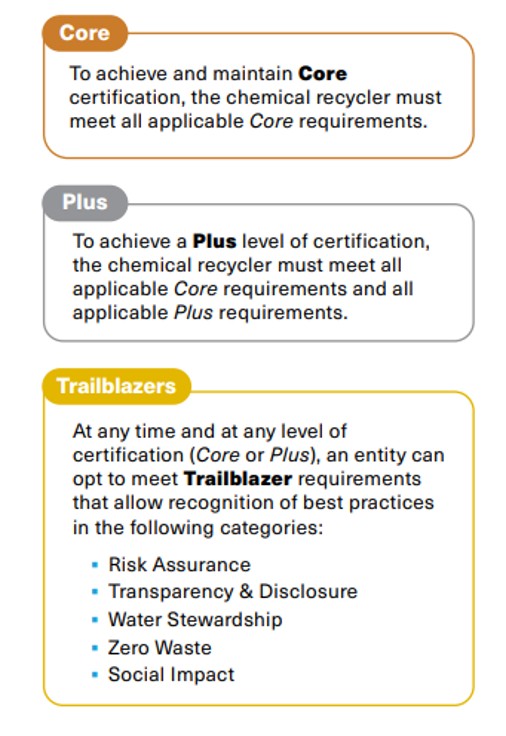
Certification is technology-agnostic and applies globally to processes such as pyrolysis, solvolysis, depolymerization, methanolysis, and gasification. It includes a flexible tiered structure that enables continuous improvement and recognition through Trailblazer categories.
Why Choose SCS Global Services?
At SCS Global Services, we bring over 40 years of experience in third-party certification and sustainability assurance, helping organizations build trust and demonstrate leadership. We have played a key role in the development of standards and frameworks across industries, working closely with technical experts, stakeholders, and global initiatives to advance responsible practices.
Our team combines deep technical expertise with practical implementation knowledge, ensuring efficient, reliable certification processes tailored to complex sectors like chemical recycling. We support organizations worldwide with strong audit capabilities, responsiveness, and commitment to excellence.
At SCS Global Services we stay informed of evolving requirements to provide certifications that strengthen sustainability and lead in emerging markets like advance recycling.
- Benefits
- Program Details
- FAQs
- Documents
- Certification enables recyclers to validate their environmental and social performance while strengthening their position in the circular economy.
- Certification enhances credibility, reduces reputational risk, and supports customer and regulatory requirements for traceability and responsible production.
- The standard is technology-agnostic and applies globally to various chemical recycling processes, including pyrolysis, solvolysis, depolymerization, methanolysis, and gasification. It also incorporates a flexible, tiered structure, allowing companies to progress and showcase leadership through Trailblazer categories.
Certification is achieved through independent third-party audits assessing compliance with requirements across operational transparency, environmental impact, and social responsibility. Companies can pursue Core or Plus certification levels, with optional recognition for advanced leadership practices.
What is Responsible Chemical Recycling?
Responsible Chemical Recycling certification is underpinned by SCS 004 Certification Standard for Responsible Chemical Recycling. Certification ensures transparency, traceability, and credible environmental and social performance across advanced recycling operations.
Who can be certified?
The certification applies to chemical recyclers worldwide, including companies processing polymers such as plastics, textiles, and elastomers, using technologies like pyrolysis, depolymerization, solvolysis, or gasification.
What chain of custody approaches are recognized?
The standard requires disclosure of the chain of custody model used, whether it’s identify preserved, segregated, controlled blending, or mass balance. If mass balance is used, the attribution approach must also be disclosed, whether it’s material-to-material attribution or energy use attribution.
What is the certification process?
The certification process involves an independent third-party audit to assess compliance with requirements related to operational transparency, environmental impact, and social responsibility. Companies can enter at Core or Plus levels and may pursue additional Trailblazer recognition for advanced practices.
What is this certification frequency?
Certification is maintained through ongoing compliance and periodic audits to ensure continued adherence to the standard requirements and performance criteria.
How much does it cost?
Certification costs vary depending on factors such as company size, scope, number of sites, and complexity of operations. Your company can provide this information on the application form. Please contact us for a tailored quote.
| Document Name | Document |
|---|---|
| SCS Standard_004_V1.0 (2026) | English |
Request Information
Ready to get started or need more info? Connect with us.
EBC Business Group
Service Brochure
Responsible Chemical Recycling Certification Brochure
English